


Danielle Smith’s Love Letter to Quebec
Albertans aren’t known to fawn over Quebec. But their premier sees an ally in seeking control over immigration.
Michael Harris TodayThe Tyee
Michael Harris, a Tyee contributing editor, is a highly awarded journalist and documentary maker.
Our journalism is supported by readers like you. Click here to support The Tyee.
Listen to this article
9 min
Separatism in Canada makes for some strange bedfellows. The United Conservative Party membership in Alberta includes separatists that Premier Danielle Smith depends on for her support. She is now looking for validation from Quebec, the province that has historically been the focus for Alberta’s antipathy towards Eastern Canada.
Announcements, Events & more from Tyee and select partners
At Knowledge Network, Indigenous Brilliance Shines On
The BC-based public broadcaster delivers 12 powerful films and original series to mark Indigenous History Month.
Alberta has clashed with Quebec over the environment, the development of pipeline projects, and the equalization program that benefits La Belle Province more than any other province.
But change is in the air. Earlier this month Smith travelled to Quebec City to meet Quebec Premier Christine Fréchette, leader of the Coalition Avenir Québec. The CAQ is considered a nationalist and populist conservative party with a “restrictive stance” on immigration. Much like Smith and the UCP, the CAQ believes Quebec will thrive if the federal government grants more powers to the province.
Ahead of the meeting Smith told journalists, “We often get a lot of wisdom from some of the legislation going through the Quebec legislature, which I’m watching with great interest.”
The two premiers highlighted their provincial economic ties and shared desire for more autonomy within the Canadian federation. In the face of uncertainty with the United States, Canada’s largest trading partner, Smith said, “the best way to support resilience is to support each other and to have more trade with each other.” The two provinces currently do $29 billion in trade together.
The Tyee is supported by readers like you
Join us and grow independent media in Canada
Both leaders expressed support for a united Canada even if both have separatists or people who were separatists in their parties.
The difference is that Fréchette, unlike Smith, opposes holding another referendum in Quebec at a time of global economic uncertainty.
Premier Smith said, “I’m here to reinforce the Alberta-Quebec relationship to ensure our governments, our economies and our peoples are building strong, autonomous provinces within a united Canada.”
But the unity pitch came with an important caveat. Smith said both provinces had been dealing with a federal government “that has refused to listen to our needs and ignores the constitutional rights of our provinces.”
A shared focus on immigration
It’s no accident that Smith travelled to express friendship with Coalition Avenir Québec. She flagged the unique way that Quebec controls its immigration system — via the Canada-Quebec Accord — as a model for Alberta.
Indeed, the Alberta referendum in October will include questions about provincial control over the services it provides to non-permanent residents — which has a whiff of blaming immigrants for economic problems.
Smith was also keen on an east-west energy corridor to Quebec. “Both Alberta and Quebec stand to gain so much from working together. Our economic strengths complement each other in so many ways.”
She may admire, as well, how Quebec’s leaders have sympathetically addressed the separatist impulse within their population without fomenting outright secession.
The Coalition Avenir Québec is a nationalist coalition party that includes federalists as well as politicians who previously supported Quebec sovereignty. It advocates for greater provincial autonomy within Canada. It was founded in 2011 to focus on the economy, health care and education. Co-founder and former leader François Legault, once a prominent supporter of separation, declared the separatist debate dead in 2016.
The separatist Parti Québécois has also highlighted plans to maintain contact with the Alberta separatist movement. PQ Leader Paul St-Pierre Plamondon said he had been open about his communications with Alberta separatists for several months.
Plamondon said he would acknowledge Alberta sovereignty if it voted to separate. There is a certain irony in that, since tax money from Alberta used for federal equalization payments is a major bone of contention in Alberta. Meanwhile, Quebec receives more equalization payments than any other province.
Separatism as signals
If a referendum were held today in Quebec, 26 per cent of its citizens would vote to separate, according to a survey conducted in February by the Angus Reid Institute.
That’s a higher percentage than in Alberta. According to a recent Ipsos poll, only 18 per cent of Albertans said they would vote to leave Canada, a 10-point drop since January.
But it would be a mistake to stop worrying about the separatist vote in Alberta just because support seems to be waning. The MAGA-aligned Christian nationalists and disgruntled conservatives who form the backbone of the movement will keep playing grievance politics until they get what they want.
And to Albertans’ claims of being victimized, just as many in Canada will respond with frustration. In an interesting article on Substack, Darcy McNeil provides his own calculation of how the scales are tipped. He figures Alberta has given Canada $750 billion. But Canada and the First Nations have given Alberta $1.8 trillion in land, royalties and workers educated and trained in other provinces who were job-ready when they moved to Alberta.
Those who would choose to leave Canada might consider a cautionary tale from across the pond. Ten years after Brexit, two out of three British citizens now want a closer relationship with the European Union it voted to leave. Hopes for a better life outside the EU did not materialize. Researchers conclude that leaving the EU has reduced Britain’s GDP by six to eight per cent.
While Alberta’s separatists look to the MAGA movement in the United States as natural allies, they might take another lesson from post-Brexit U.K. Today the Brits favour Europe over the United States as a favoured security partner. Just 18 per cent view Trump’s America as an ally.
What, then, does Ottawa owe provinces where talk of pulling out of the Confederation persists like a low-grade fever?
In a speech to Albertans on June 8 at the Royal Canadian Legion in downtown Calgary, Pierre Poilievre made the case for national unity and for a reform of federalism.
Separatist sentiment, he said, was caused by federal policies “that stymied provincial authority and autonomy.” He also believed Canada’s common history and identity had been “downgraded and denigrated.” He urged Albertans and also Canadians in other provinces to find common causes with other jurisdictions that also want greater control over their provincial affairs.
Here’s how Poilievre put it:
What Smith Gets Wrong about Alberta and Quebec Separatism
“Listen carefully to the concerns of those saying that they want to leave,” he advised. “And you will find that they do not have a problem with fellow Canadians or even with Canada itself. They had a problem with the federal government.”
Poilievre is partially right but mostly playing politics. Whatever his shortcomings, it is obvious Prime Minister Mark Carney has already shown that Ottawa is listening. In May, he and Premier Smith announced a landmark energy and climate agreement in Calgary that included support for a new West Coast oil pipeline to Asian markets.
What is fair game?
But could Ottawa do more to find common causes? In a Sunday editorial the Globe and Mail warned against underestimating the threat of separatism. “Dismissing the independence movement is a mistake. Instead, Ottawa should move decisively to deal with the province’s legitimate grievances.”
Which naturally raises the basic question of which grievances amount to more than political grist and are truly legitimate.
Is control of immigration a legitimate grievance? Should all provinces be able to control who settles in them?
What about how Ottawa doles out cash to the provinces? The federal government might be wise to take another look at the equalization formula that offends so many Albertans.
Then there is political representation itself. Should population be the determining factor in seat distribution in the House of Commons? Alberta, for example, has one seat per 135,000 people, while Quebec has one per 117,000 people. Still better represented per capita is Prince Edward Island. It has one seat for every 45,000 people.

Among the Separatists
Not to be forgotten are the grievances related to COVID 19, and the 2022 convoy protests in Ottawa and Coutts, Alberta, that still fester in the West — particularly within the separatist movement.
Quebec’s election will happen just two weeks before Alberta votes on Premier Smith’s independence question.
Separatists in both provinces should reflect on the buyer’s remorse in the U.K. over Brexit. The grass is not always greener on the other side of the fence.
But Canada’s political leaders also have something to consider. The persistent grievances of would-be separatists must be acknowledged and addressed with an open mind and open heart, with generosity and respect.
The good news is that the PM is temperamentally suited to that job. He also has a pretty good product to market. After all, Canada is the most loved country in the world. ![[Tyee]](https://thetyee.ca/design-article.thetyee.ca/ui/img/yellowblob.png)
Read more: Alberta
Independent journalism thrives when readers choose to support it Danielle Smith’s Love Letter to Quebec
Albertans aren’t known to fawn over Quebec. But their premier sees an ally in seeking control over immigration.
Michael Harris TodayThe Tyee
Michael Harris, a Tyee contributing editor, is a highly awarded journalist and documentary maker.
Our journalism is supported by readers like you. Click here to support The Tyee.
8
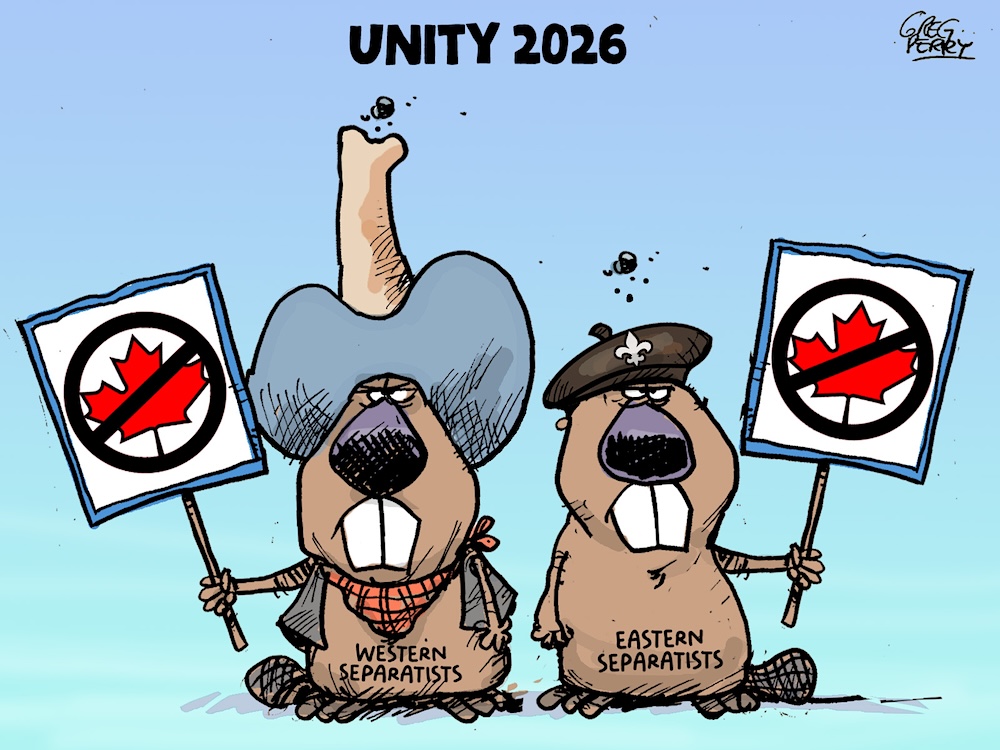
A cartoon with the title ‘Unity 2026’ shows two beavers: one wearing a cowboy hat and labelled ‘Western Separatists,’ and the other wearing a fleur-de-lis beret and labelled ‘Eastern Separatists.’ Both hold up signs with a crossed-out Maple Leaf.
Cartoon by Greg Perry.
Listen to this article
9 min
Separatism in Canada makes for some strange bedfellows. The United Conservative Party membership in Alberta includes separatists that Premier Danielle Smith depends on for her support. She is now looking for validation from Quebec, the province that has historically been the focus for Alberta’s antipathy towards Eastern Canada.
Announcements, Events & more from Tyee and select partners
At Knowledge Network, Indigenous Brilliance Shines OnAt Knowledge Network, Indigenous Brilliance Shines On
The BC-based public broadcaster delivers 12 powerful films and original series to mark Indigenous History Month.
Alberta has clashed with Quebec over the environment, the development of pipeline projects, and the equalization program that benefits La Belle Province more than any other province.
But change is in the air. Earlier this month Smith travelled to Quebec City to meet Quebec Premier Christine Fréchette, leader of the Coalition Avenir Québec. The CAQ is considered a nationalist and populist conservative party with a “restrictive stance” on immigration. Much like Smith and the UCP, the CAQ believes Quebec will thrive if the federal government grants more powers to the province.
Ahead of the meeting Smith told journalists, “We often get a lot of wisdom from some of the legislation going through the Quebec legislature, which I’m watching with great interest.”
The two premiers highlighted their provincial economic ties and shared desire for more autonomy within the Canadian federation. In the face of uncertainty with the United States, Canada’s largest trading partner, Smith said, “the best way to support resilience is to support each other and to have more trade with each other.” The two provinces currently do $29 billion in trade together.
The Tyee is supported by readers like you
Join us and grow independent media in Canada
Both leaders expressed support for a united Canada even if both have separatists or people who were separatists in their parties.
The difference is that Fréchette, unlike Smith, opposes holding another referendum in Quebec at a time of global economic uncertainty.
Premier Smith said, “I’m here to reinforce the Alberta-Quebec relationship to ensure our governments, our economies and our peoples are building strong, autonomous provinces within a united Canada.”
But the unity pitch came with an important caveat. Smith said both provinces had been dealing with a federal government “that has refused to listen to our needs and ignores the constitutional rights of our provinces.”
A shared focus on immigration
It’s no accident that Smith travelled to express friendship with Coalition Avenir Québec. She flagged the unique way that Quebec controls its immigration system — via the Canada-Quebec Accord — as a model for Alberta.
Indeed, the Alberta referendum in October will include questions about provincial control over the services it provides to non-permanent residents — which has a whiff of blaming immigrants for economic problems.
Smith was also keen on an east-west energy corridor to Quebec. “Both Alberta and Quebec stand to gain so much from working together. Our economic strengths complement each other in so many ways.”
She may admire, as well, how Quebec’s leaders have sympathetically addressed the separatist impulse within their population without fomenting outright secession.
The Coalition Avenir Québec is a nationalist coalition party that includes federalists as well as politicians who previously supported Quebec sovereignty. It advocates for greater provincial autonomy within Canada. It was founded in 2011 to focus on the economy, health care and education. Co-founder and former leader François Legault, once a prominent supporter of separation, declared the separatist debate dead in 2016.
The separatist Parti Québécois has also highlighted plans to maintain contact with the Alberta separatist movement. PQ Leader Paul St-Pierre Plamondon said he had been open about his communications with Alberta separatists for several months.
Plamondon said he would acknowledge Alberta sovereignty if it voted to separate. There is a certain irony in that, since tax money from Alberta used for federal equalization payments is a major bone of contention in Alberta. Meanwhile, Quebec receives more equalization payments than any other province.
Separatism as signals
If a referendum were held today in Quebec, 26 per cent of its citizens would vote to separate, according to a survey conducted in February by the Angus Reid Institute.
That’s a higher percentage than in Alberta. According to a recent Ipsos poll, only 18 per cent of Albertans said they would vote to leave Canada, a 10-point drop since January.
But it would be a mistake to stop worrying about the separatist vote in Alberta just because support seems to be waning. The MAGA-aligned Christian nationalists and disgruntled conservatives who form the backbone of the movement will keep playing grievance politics until they get what they want.
And to Albertans’ claims of being victimized, just as many in Canada will respond with frustration. In an interesting article on Substack, Darcy McNeil provides his own calculation of how the scales are tipped. He figures Alberta has given Canada $750 billion. But Canada and the First Nations have given Alberta $1.8 trillion in land, royalties and workers educated and trained in other provinces who were job-ready when they moved to Alberta.
Those who would choose to leave Canada might consider a cautionary tale from across the pond. Ten years after Brexit, two out of three British citizens now want a closer relationship with the European Union it voted to leave. Hopes for a better life outside the EU did not materialize. Researchers conclude that leaving the EU has reduced Britain’s GDP by six to eight per cent.
While Alberta’s separatists look to the MAGA movement in the United States as natural allies, they might take another lesson from post-Brexit U.K. Today the Brits favour Europe over the United States as a favoured security partner. Just 18 per cent view Trump’s America as an ally.
What, then, does Ottawa owe provinces where talk of pulling out of the Confederation persists like a low-grade fever?
In a speech to Albertans on June 8 at the Royal Canadian Legion in downtown Calgary, Pierre Poilievre made the case for national unity and for a reform of federalism.
Separatist sentiment, he said, was caused by federal policies “that stymied provincial authority and autonomy.” He also believed Canada’s common history and identity had been “downgraded and denigrated.” He urged Albertans and also Canadians in other provinces to find common causes with other jurisdictions that also want greater control over their provincial affairs.
Here’s how Poilievre put it:
image atom
What Smith Gets Wrong about Alberta and Quebec Separatism
read more
“Listen carefully to the concerns of those saying that they want to leave,” he advised. “And you will find that they do not have a problem with fellow Canadians or even with Canada itself. They had a problem with the federal government.”
Poilievre is partially right but mostly playing politics. Whatever his shortcomings, it is obvious Prime Minister Mark Carney has already shown that Ottawa is listening. In May, he and Premier Smith announced a landmark energy and climate agreement in Calgary that included support for a new West Coast oil pipeline to Asian markets.
What is fair game?
But could Ottawa do more to find common causes? In a Sunday editorial the Globe and Mail warned against underestimating the threat of separatism. “Dismissing the independence movement is a mistake. Instead, Ottawa should move decisively to deal with the province’s legitimate grievances.”
Which naturally raises the basic question of which grievances amount to more than political grist and are truly legitimate.
Is control of immigration a legitimate grievance? Should all provinces be able to control who settles in them?
What about how Ottawa doles out cash to the provinces? The federal government might be wise to take another look at the equalization formula that offends so many Albertans.
Then there is political representation itself. Should population be the determining factor in seat distribution in the House of Commons? Alberta, for example, has one seat per 135,000 people, while Quebec has one per 117,000 people. Still better represented per capita is Prince Edward Island. It has one seat for every 45,000 people.
image atom
Among the Separatists
read more
Not to be forgotten are the grievances related to COVID 19, and the 2022 convoy protests in Ottawa and Coutts, Alberta, that still fester in the West — particularly within the separatist movement.
Quebec’s election will happen just two weeks before Alberta votes on Premier Smith’s independence question.
Separatists in both provinces should reflect on the buyer’s remorse in the U.K. over Brexit. The grass is not always greener on the other side of the fence.
But Canada’s political leaders also have something to consider. The persistent grievances of would-be separatists must be acknowledged and addressed with an open mind and open heart, with generosity and respect.
The good news is that the PM is temperamentally suited to that job. He also has a pretty good product to market. After all, Canada is the most loved country in the world. [Tyee]
Read more: Alberta
Independent journalism thrives when readers choose to support it
Nearly every week, I see newspapers and magazines that seemed fine suddenly going out of business. Or a private equity fund buying up a chain of newspapers that had been serving communities for decades and stripping them for parts. And now, the thing that’s making all publishers wring their hands is AI – publishers are seeing massive drops to their web visits as AI scrapes their content and delivers it up to people in chatbots, with the journalists who did the original work not even credited with the work.
Despite this, I have hope for journalism because of what’s happening at The Tyee.
Years ago, we made a strategic bet that support from our readers was going to drive our whole future. And thankfully, that is working for us.
Over the past decade, we’ve more than doubled our journalism team and are publishing more work than ever. More people read The Tyee now than at any point in our 23-year history.
This is only possible because we regularly ask our readers to sign up as paying Tyee Builder members. Roughly half of our entire budget is made up of contributions from over 10,000 readers.
We’ve been doing more as our resources have grown. A weekend culture section filled with original essays. Hard-hitting investigative journalism in Alberta. A brand new biodiversity beat. A reporting project called Reality Check, focusing on misinformation and online radicalization. A flagship podcast.
Our model is simple: if more of our readers sign up to support The Tyee, we can keep up with rising costs and keep adding more talented journalists to our roster and set them loose on uncovering truths that would otherwise not see the light of day.
Please help us prove that Independent Journalism Thrives with reader support.
— Jeanette Ageson, Publisher
Support us now
Nearly every week, I see newspapers and magazines that seemed fine suddenly going out of business. Or a private equity fund buying up a chain of newspapers that had been serving communities for decades and stripping them for parts. And now, the thing that’s making all publishers wring their hands is AI – publishers are seeing massive drops to their web visits as AI scrapes their content and delivers it up to people in chatbots, with the journalists who did the original work not even credited with the work.
Despite this, I have hope for journalism because of what’s happening at The Tyee.
Years ago, we made a strategic bet that support from our readers was going to drive our whole future. And thankfully, that is working for us.
Over the past decade, we’ve more than doubled our journalism team and are publishing more work than ever. More people read The Tyee now than at any point in our 23-year history.
This is only possible because we regularly ask our readers to sign up as paying Tyee Builder members. Roughly half of our entire budget is made up of contributions from over 10,000 readers.
We’ve been doing more as our resources have grown. A weekend culture section filled with original essays. Hard-hitting investigative journalism in Alberta. A brand new biodiversity beat. A reporting project called Reality Check, focusing on misinformation and online radicalization. A flagship podcast.
Our model is simple: if more of our readers sign up to support The Tyee, we can keep up with rising costs and keep adding more talented journalists to our roster and set them loose on uncovering truths that would otherwise not see the light of day.Please help us prove that Independent Journalism Thrives with reader support.
— Jeanette Ageson, PublisherSupport us now


